 英语
 西班牙语
 中文简体
Choosing a biodegradable wet-wipe material requires more than a plant-based label. Learn how to compare fibers, performance, disposal routes, test standards, and environmental claims.
Start with the intended disposal environment, not the fiber name. Then shortlist materials, validate wet-use performance and lotion compatibility, verify supply-chain documentation, and test the finished wipe against the standard that supports the intended claim. Viscose, lyocell, wood pulp, cotton, and other plant-derived fibers may all be candidates, but none of these names alone proves that the finished product is biodegradable or compostable.
Why “plant-based” is not enough
Several terms used in wet-wipe marketing describe different attributes and should not be treated as synonyms:
Bio-based
- describes where a material comes from; it does not automatically show how it behaves after disposal.
Biodegradable
- must be tied to an environment, test method, duration, and measured result.
Compostable
- requires more than biodegradation. Relevant schemes also assess disintegration, ecotoxicity, and heavy metals.
Plastic-free
- is a composition claim, not proof of compostability.
Flushable
- concerns disintegration and transport through wastewater systems; it is not established by a biodegradation test.
TÜV AUSTRIA explains that biodegradable and compostable do not mean the same thing, and that a product certified only for industrial composting may not compost under cooler home-composting conditions. Unless a finished wipe has passed a recognized flushability assessment for its target market, conventional baby, cosmetic, pet, and household wipes should be disposed of in a bin rather than flushed.
Define the intended disposal route
Material selection should work backward from where the used wipe is expected to go.
Industrial composting
If a brand intends to claim industrial compostability, the material system and finished product should be suitable for testing under industrial composting conditions. TÜV AUSTRIA states that industrial composting facilities operate at approximately 55–60°C. Its explanation of EN 13432 identifies four areas of assessment:
- biodegradation;
- disintegration;
- ecotoxicity;
- heavy-metal content.
A biodegradation report for a raw fiber therefore does not, by itself, prove that a complete wet wipe containing a substrate, lotion, and other components is industrially compostable.
Home composting
Home composting typically runs at lower temperatures than industrial composting. A home-compostable statement should be supported by evidence specifically relevant to home-composting conditions. An industrial compostability certificate should not be presented as proof of home compostability.
General household waste
Unqualified biodegradable claims require particular care when consumers normally discard the product with household waste. The U.S. FTC Green Guides state that an unqualified degradable claim requires proof that the entire product or package will completely break down and return to nature within a reasonably short time after customary disposal. For solid-waste products, the FTC describes that period as one year and notes that items normally sent to landfill, incineration, or recycling do not degrade within one year; unqualified biodegradable claims should therefore not be made for them.
Step 2: Compare fibers on evidence and performance
|
Candidate material |
What to evaluate positively |
What to verify before purchase |
Typical product direction |
|
Viscose |
Hand feel, liquid absorption, and converting compatibility |
Pulp origin, production route, chain-of-custody evidence, and finished-product testing |
Baby, personal-care, cosmetic, and general-purpose wipes |
|
Lyocell |
Balance of softness and wet-use performance |
Cost, supply continuity, composition, and finished-product evidence |
Premium personal care and sensitive-skin products |
|
Wood-pulp/cellulose composites |
Absorption and flexible substrate engineering |
Wet strength, linting, surface feel, and composition of supporting fibers |
Household cleaning and general-care wipes |
|
Cotton |
Familiar natural-fiber positioning and softness |
Cost, batch consistency, source traceability, and processing aids |
Premium baby, facial, and sensitive-skin wipes |
|
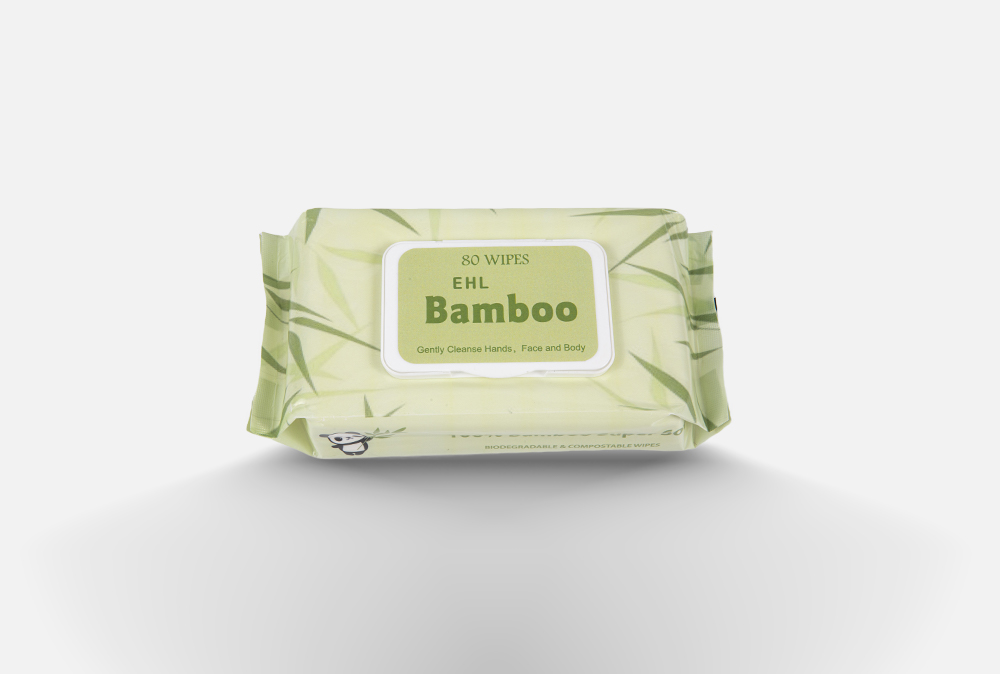
Bamboo-derived cellulose |
Plant-derived sourcing story |
Whether the material is mechanically processed bamboo or regenerated fiber made from bamboo pulp |
Personal-care products with a plant-origin positioning |
|
Bio-based polymers or composite fibers |
Tailored structure and performance |
Bio-based does not mean biodegradable in every environment; require disposal-specific evidence |
Custom projects with a clearly defined certification goal |
Ask what “bamboo fiber” actually means
A specification should not stop at the word “bamboo.” Ask whether the material is mechanically extracted bamboo fiber or a regenerated fiber made from bamboo-derived pulp. Require the precise fiber name, percentage composition, and supply-chain documentation. This prevents a feedstock claim from being confused with the chemistry and disposal behavior of the final fiber.
Disclose every component in a blend
Even a small amount of polyester, polypropylene, or another reinforcing fiber can affect composition claims, disposal instructions, and labeling obligations. The European Commission states that, from 3 July 2021, specified single-use plastic products placed on the EU market must bear harmonized marking. The listed products include pre-wetted personal-care and domestic wipes. Exporters should therefore verify the complete fiber composition, not merely the majority component.
Step 3: Match the substrate to the use case
Environmental positioning does not replace functional performance. EHLifeCare recommends testing several basis weights, fiber ratios, and surface patterns rather than applying the same specification across different products.
Wet strength and elongation
Baby and household cleaning wipes generally need to remain intact after absorbing the lotion. Facial wipes may place greater emphasis on softness and low friction. Evaluate the material with the actual lotion load, formula, shelf-life conditions, and intended wiping action rather than relying solely on dry-roll data.
Liquid uptake and release
Liquid absorption is one of several performance factors. The substrate should release lotion evenly and avoid excessive wetness at opening, dry wipes near the end of the pack, or heavy residue after use. Testing should be performed in the final pack format and include storage and transportation conditions.
Linting, friction, and skin-contact experience
Facial, baby, and intimate-care products should be compared for linting, surface roughness, and comfort during repeated wiping. Household and pet-care wipes may require more texture to provide mechanical cleaning.
Lotion and packaging compatibility
A biodegradable substrate is one part of the product. Surfactants, preservatives, fragrances, packaging films, lids, labels, and adhesives have separate environmental and regulatory profiles. Marketing should clearly state whether a claim applies to the wipe substrate, the packaging, or the finished product.
Step 4: Use a test that matches the claim
What does ISO 14855-1 demonstrate?
ISO 14855-1:2012 determines the ultimate aerobic biodegradability of plastic materials under controlled composting conditions by measuring evolved carbon dioxide and the degree of disintegration at the end of the test. ISO states that this edition was reviewed and confirmed in 2022 and remains current.
The method addresses performance under controlled composting conditions. It does not prove equivalent degradation in marine water, soil, a home compost bin, or landfill.
What does ASTM D5511 demonstrate?
ASTM D5511 evaluates plastic materials under high-solids anaerobic-digestion conditions. Its scope specifies conditions with more than 30% total solids. ASTM also states that performance claims should be limited to the numerical result of the test and should not be converted into an unqualified “biodegradable” claim or extrapolated beyond the actual test duration.
How should a supplier test report be reviewed?
A commercially useful report should answer at least seven questions:
- Was the sample a raw fiber, dry substrate, lotion-loaded wipe, or complete packaged product?
- Which standard and edition were used?
- Which environment was simulated: industrial compost, home compost, soil, marine water, or anaerobic digestion?
- How long did the test run, and what numerical result was measured?
- Can the sample number be traced to the production formula?
- Was the report issued by a competent third-party laboratory?
- Is the marketing claim limited to the conditions and scope covered by the report?
Step 5: Build a practical purchasing workflow
1. Define the product and market
Specify use, target price, sales countries, expected disposal route, and the exact environmental claim the brand wants to make.
2. Remove components that conflict with the claim
Require disclosure of every fiber and its percentage, including binders, reinforcement fibers, and coatings. If the objective is a plastic-free wipe, verify the complete substrate rather than only the main fiber.
3. Trial candidate substrates with the same formula
Compare materials using the same lotion, packaging, and storage conditions. Record wet strength, softness, liquid uptake and release, linting, odor, dispensing continuity, and pack stability.
4. Test the finished product
After the formula and packaging are fixed, test the final version against the intended claim. Raw-material certificates are useful screening documents but do not replace finished-product evidence.
5. Review packaging and website wording
Avoid broad standalone claims such as “green,” “eco-friendly,” or “biodegradable.” State the material, percentage, disposal environment, test method, and disposal instruction. A statement such as “the wipe substrate was tested under controlled industrial composting conditions according to [standard]” is specific and can be checked against supporting evidence.
Frequently Asked Questions
1. Is viscose or lyocell better for biodegradable wipes?
Both can be cellulosic candidates. Compare them in the actual product for softness, wet strength, formula compatibility, cost, sourcing documentation, and the certification goal.
2. Can plant-derived materials be treated as home compostable?
No. Plant-derived describes feedstock; home compostable describes performance in a specific disposal environment. A home-compostable claim needs evidence relevant to that environment.
3. Can a biodegradable wipe be flushed?
Not on that basis alone. Biodegradability and flushability are different performance questions. Unless the finished wipe passes a recognized flushability assessment and meets local requirements, it should carry a “Do Not Flush” disposal instruction.
4. If the raw material is certified compostable, must the finished wipe still be tested?
Yes. Substrate structure, fiber ratio, binders, lotion, and product shape can affect disintegration and degradation. The final commercial claim should be supported by the finished product or an equivalent production sample.
5. Does plastic-free mean biodegradable?
No. Plastic-free is a composition claim. Biodegradable is a performance claim tied to an environment, time, and method. They require different evidence.
6. Must the pack also be biodegradable?
Not necessarily, but the claim must distinguish the wipe from the pack. If only the substrate meets the stated requirement, the wording should not imply that the entire packaging system is biodegradable or compostable.
Conclusion: Move from a green-sounding material to a verifiable product
A practical way to select a biodegradable wet-wipe material is to build an evidence chain: define the disposal route, disclose each component, validate use performance, test the finished product, and limit claims to what the evidence supports.
For custom wet-wipe projects, EHLifeCare can compare material prototypes around product use, target market, hand feel, strength, fiber sourcing, and testing objectives. Defining the claim boundary at the start of development is usually more effective than searching for supporting certificates after the product has already been finalized.